SEACPL helps industrial plants design, upgrade, and operate compressed air systems that deliver stable pressure, lower power cost, and reliable operation — without oversizing or firefighting
Most plants buy a good compressor — yet still struggle with high power bills, pressure drops, and frequent complaints from production.
That happens because compressed air losses are usually system-level, not equipment-level.
Compressed air is one of the costliest utilities in a plant.
Most losses stay invisible until power bills make them obvious.
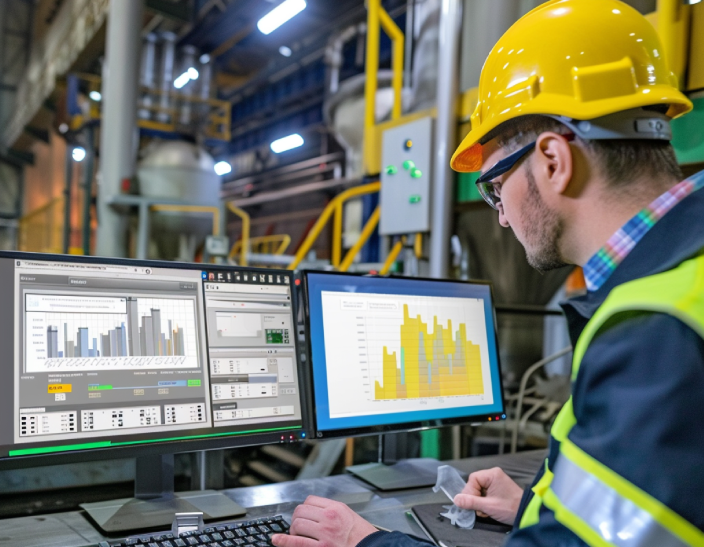
Air efficiency is created downstream — not inside the compressor alone.

We start by understanding how air is actually consumed:
We design systems for:
SEACPL manages:
Post-installation, we focus on:
For compressed air equipment, SEACPL works with Anest Iwata Motherson, a proven manufacturer of industrial air compressors.
Anest Iwata Motherson provides reliable, well-engineered machines.
SEACPL ensures they are applied correctly, integrated properly, and operated efficiently.
This approach avoids:
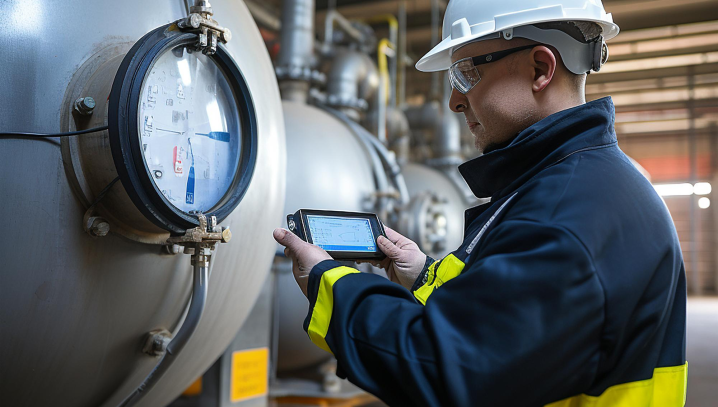
SEACPL’s compressed air philosophy is shaped by Jaydip Gandhi, a business leader and engineer with over 32 years of experience across industrial utilities, energy systems, and plant operations.
Having worked on both OEM and plant-side challenges, his focus is helping leadership teams make technically defensible compressed air decisions — especially where power cost, reliability, and uptime matter.
Jaydip Gandhi works as a Business Growth Advisor and utility expert, with SEACPL acting as the execution arm for engineered compressed air solutions.
Short, practical observations on pressure discipline, leak economics, and energy efficiency — drawn from operating plants.
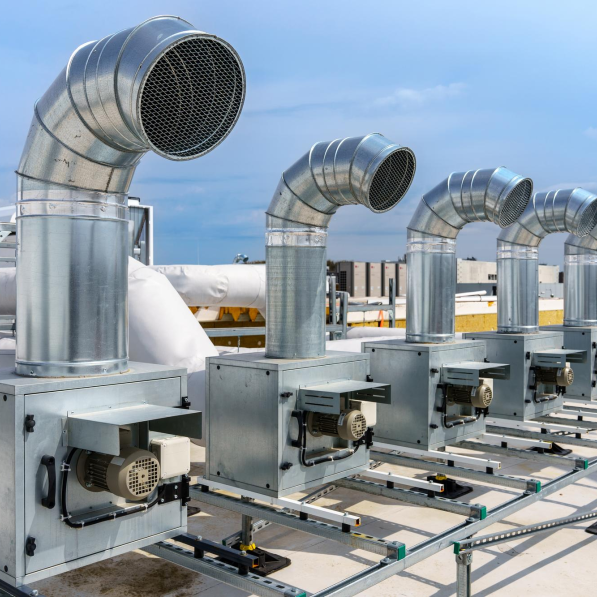
A short review costs nothing. Getting it wrong costs for years.
Complimentary review (typically part of a ₹10,000+ diagnostic exercise)

At Shreejiinc Engineering And Consultancy, we’ve been building strong relationships with clients across India for over a decade.


 +91 7798985580
 jgandhi@shreejiinc.co.in
Shed No – 60 Gajanand Inc Hub- 2 Behind Metrics Plaza, Ahmedabad, Gujarat – 382445, India
 U29299GJ2022PTC130700