Why steam systems underperform in real plants

Most steam systems are designed correctly on paper yet underperform in daily operation.
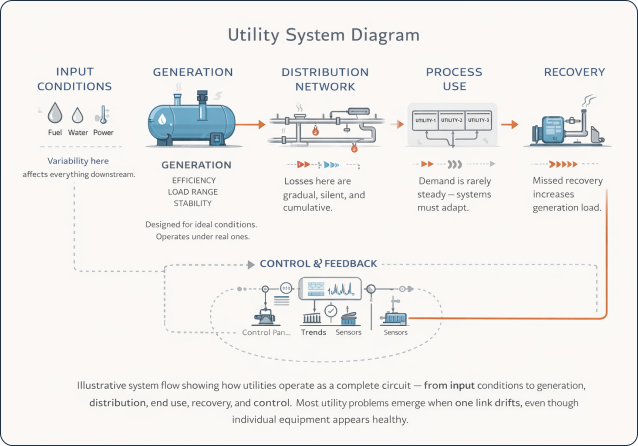
The gap appears because real plants don’t behave like test conditions.
Common causes we see across industries:

Design & sizing

  • Boilers sized for peak load, not running reality
  • Fuel quality and air density changing with seasons

Operation & discipline

  • Blowdown, excess air, and condensate recovery drift
  • Operators inheriting systems without design clarity

System losses

  • Distribution losses and rising stack temperature
  • No single owner tracking end-to-end performance

When steam performance drops, the problem is rarely the boiler alone.
It’s the system thinking around it.

We engineer the full steam ecosystem not just the boiler

Our scope covers the complete steam lifecycle:

  • Steam generation and load matching
  • Combustion efficiency and excess air control
  • Blowdown strategy and heat recovery
  • Condensate recovery and return integrity
  • Distribution losses and pressure stability
  • Fouling, scale, and soot impact on heat transfer
  • Operability, maintenance discipline, and audit readiness

Efficiency is not a feature.
It is the outcome of disciplined system design — and disciplined operation.

How SEACPL approaches steam projects

Our engineering-led approach to steam systems

This is why clients involve SEACPL before specifications are frozen not after fuel bills start rising.

    Assess

    We start by understanding how steam is actually used:

    • Load patterns and variability
    • Fuel characteristics and seasonal effects
    • Water chemistry and blowdown practices
    • Existing losses — visible and hidden

    Engineering

    We design for:

    • Stable operation across load ranges
    • Efficiency that survives real conditions
    • Margin against fouling, drift, and human factors
    • Compliance and long-term operability

    Execute

    SEACPL coordinates:

    • Boiler and auxiliary equipment
    • OEM interfaces and site realities
    • Installation logic and commissioning clarity

    Support

    We focus on:

    • Performance tracking
    • Predictive indicators, not reactive firefighting
    • Keeping efficiency, reliability, and compliance intact over time

Strong engineering needs reliable manufacturing partners

For steam generation, SEACPL works with Cheema Boilers Limited — a proven Indian manufacturer of process steam boilers.
Cheema Boilers provides the manufacturing backbone.
SEACPL owns system design, application engineering, and performance responsibility.

This ensures:

  • Correct boiler selection
  • Proper integration with plant utilities
  • Long-term support logic — not just supply

This ensures engineering decisions are not compromised by:

Where our steam engineering delivers the most value

  • When fuel cost per ton of steam doesn’t match expectations
  • When pressure fluctuates during peak or variable loads
  • When audits highlight efficiency, blowdown, or safety gaps
  • When old boilers are replaced without repeating old mistakes

When expansions need steam upgrades without surprises

Most savings come from correcting assumptions, not adding equipment.


Authority & thinking

Steam decisions are long-term decisions

SEACPL’s steam system philosophy is shaped by Jaydip Gandhi, a business leader and engineer with over 32 years of experience across steam systems, energy management, industrial utilities, and business development.

Having worked across OEM environments and operating plants, his focus today is helping leadership teams make technically defensible, long-term steam decisions especially where fuel cost, reliability, and compliance are critical.

Jaydip Gandhi works as a Business Growth Advisor and utility expert, with SEACPL serving as the execution arm for engineered steam solutions.

Practical steam insights from real plants

Short field notes drawn from real operating plants covering efficiency gaps, hidden losses, and predictive steam health.

Explore Steam & Utility Insights →

If utilities are critical to your plant, guessing is expensive.

A short review costs nothing. Getting it wrong costs for years.

Complimentary review (typically part of a ₹10,000+ diagnostic exercise)